


Once you’ve grown a solid bunch of shrooms, it’s time to harvest. The best way to do that? You’ll find it in this article. We’ll walk you through two effective methods, so keep reading and pick your favorite way to harvest your magic mushrooms!
Table of Contents
When is the best time to harvest magic mushrooms?
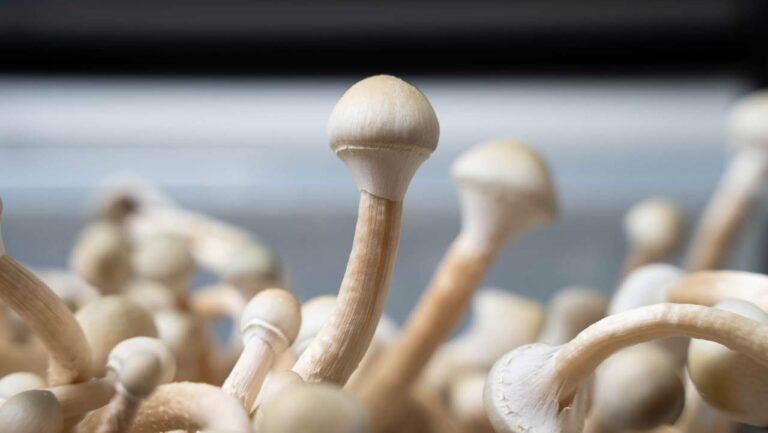
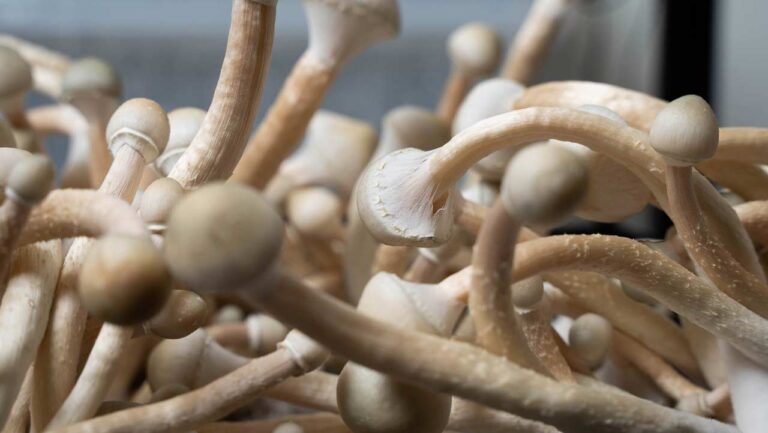
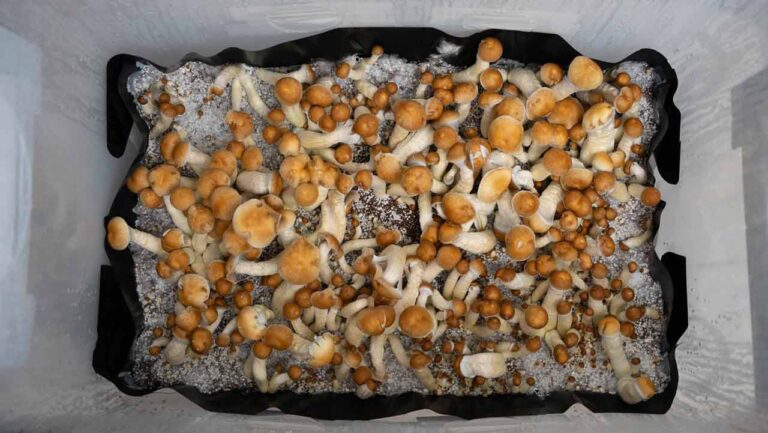
The best time to harvest magic mushrooms is when the caps are still convex—that is, dome-shaped. The veils underneath the caps will still be intact at that point. This means sporulation—the process where a mushroom produces spores—hasn’t started yet.
The main reason to harvest at this stage is that sporulation can negatively impact your grow. When spores drop onto the mycelium, it may stop producing future flushes. Basically, the mycelium “thinks” its job is done: the spores have spread. That’s something you definitely want to avoid.
Sporulation also makes harvesting messier. Magic mushrooms often end up covered in spores, making them sticky and less visually appealing. On top of that, inhaling spores isn’t great for your health, although this usually isn’t a big issue in small-scale home grows.
Below are some photos to help you recognize the perfect harvest moment.

Harvesting shrooms: two methods
Below we describe two common ways to harvest. Read on and pick the method that works best for you.
Method 1
In the first method, we remove the shrooms using a gentle twisting and pulling motion. This is the most popular method and works great for shroom varieties that detach easily from the substrate. This method causes minimal damage to the substrate.
Basically, all you need is a tray or bowl to collect your harvested shrooms. If you want to weigh your harvest, it’s a good idea to have a second container ready for that.
You might also want to use the following items:
- Nitrile gloves
- Face mask
- Disinfectant
- Fork
- Scale
Here’s how to do it:
1. Grab a shroom and remove it from the substrate
Grab a shroom or cluster at the base of the stem (close to the substrate) and remove it using a light twisting and pulling motion. For many strains, this will go smoothly.


2. Remove all shrooms from the substrate
Go over the entire substrate systematically until all shrooms have been removed. You can choose to also remove the small, underdeveloped mushrooms, but it’s not necessary. They’ll either continue growing during the next flush—or not. Either way, it’s fine; they won’t rot, despite what some people claim.

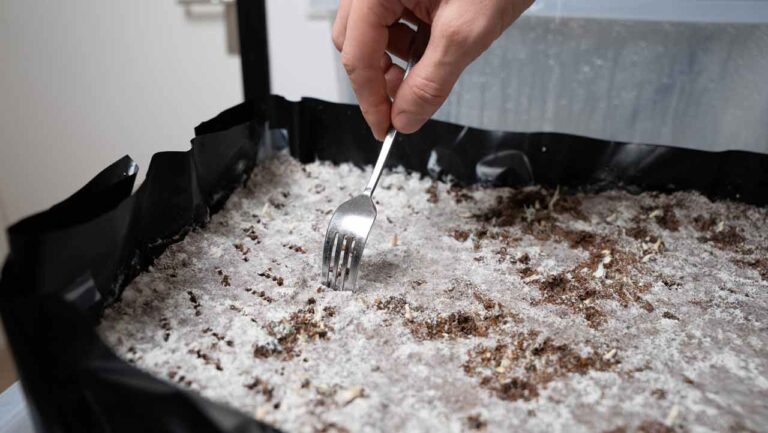
3. (Optional) Poke holes in the substrate for optimal rehydration
After all shrooms are removed, you can choose to poke a few holes in the substrate to prep it for the next step. This helps the water soak in more evenly, especially in areas where the mycelium has taken over.
Use a disinfected fork to poke the holes. This helps prevent contamination.

4. Rehydrate the substrate
Add clean water to the substrate to rehydrate it. This is essential for a successful next flush, since mushrooms are about 90% water.
If you want, use a disinfected, heavy object to weigh the substrate down and fully submerge it. Let it soak for a few hours. We find it easiest to let this happen overnight.

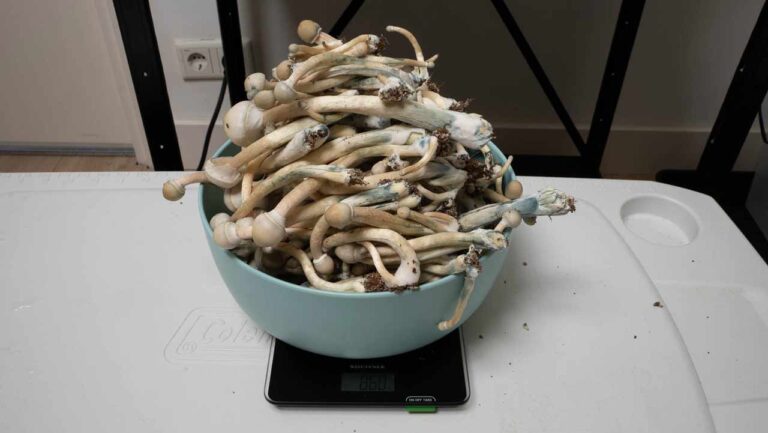
5. Weigh the harvest
Time for the moment of truth: weighing your harvest! Place an empty container on the scale and press ‘TARE’. Then place your harvested mushrooms in the container to measure the weight.

Method 2
In the second method, we remove the shrooms using a sharp knife. This method is especially useful when shrooms are firmly attached to the substrate. With method one, trying to harvest such tight shrooms can damage the substrate too much, which may reduce your chances of getting future flushes.
Despite what some people say, you don’t have to worry about leftover stumps rotting on the substrate. New mushrooms will usually grow around them, and the stumps themselves often get overgrown with active mycelium.
Just like with the first method, you’ll need two trays or containers to collect and weigh your shrooms. And again, you might want to use the following:
Apart from the supplies mentioned earlier, you may also want to consider the following items:
- Nitrile gloves
- Face mask
- Disinfectant
- Fork
- Scale
Here’s how to harvest shrooms with a knife:
1. Remove the substrate from the monotub
If possible, take the substrate out of the monotub. This is easiest if you use a liner. Grab the liner on both sides and lift the substrate out. Place it on a clean, suitable workspace.
If you didn’t use a liner, it might be tricky to remove the substrate as one piece. In that case, it’s easier to use a smaller knife so you can harvest directly inside the monotub.
If you used a grow tub without holes, you can also fill it with water. The substrate will float, making it easier to lift out of the tub.

2. Cut the shrooms off at the base
Carefully cut the shrooms from the substrate. Start on one side and work your way across. Cut as close to the substrate as you can without damaging it.


3. Remove the small mushrooms
Once most of the shrooms are removed, clean up the substrate by picking off the smaller mushrooms by hand. Try not to damage the substrate.
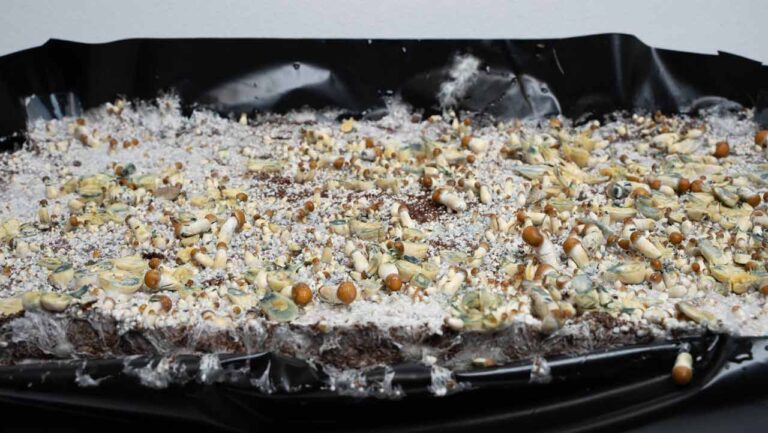
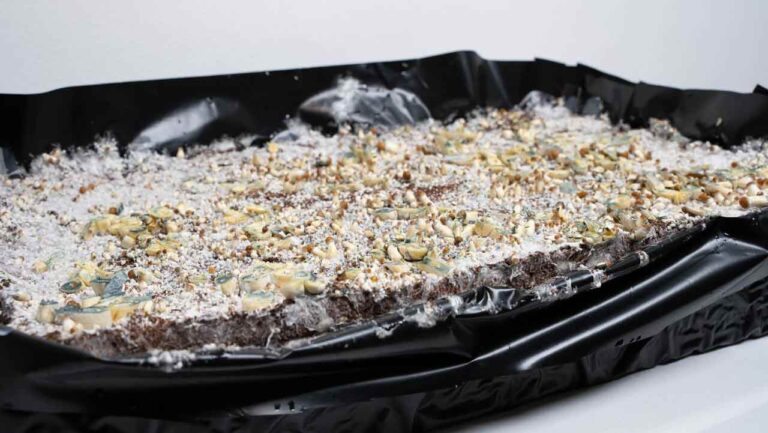
Keep in mind: it’s not necessary to remove every tiny mushroom. During the next flush, they’ll either keep growing or stop. Either way is fine.
4. (Optional) Poke holes and tape the liner around the substrate
Once you’re done harvesting, prep the mycelium for the next flush. For even rehydration, poke a few holes in the substrate again using a disinfected fork—just like in method one.
If you used a liner, you can tape it tightly around the substrate. This helps prevent shrooms from growing sideways during the next flush.


5. Weigh the harvest
Place the empty tray or container on the scale, press ‘TARE’, and add the shrooms. Weigh them and enjoy the result!

Done harvesting? Time to dry your shrooms!
That’s it for harvesting. To keep your stash fresh longer, it’s important to dry your shrooms and store them properly. We explain exactly how to do that in our article on drying and storing shrooms. Go check it out and make sure your stash stays fresh!