
Acid Shroomz » Shop » Magic mushroom spore syringes » Allenii Spore Syringe | Psilocybe allenii


€24.99
Explore the genetics of this distinctive North American woodlover with our 10 ml Psilocybe allenii spore syringe.
Known for its strong mycelial growth on woody material and cold-season fruiting, this multispore culture offers an interesting starting point for exploring one of the characteristic wood-loving Psilocybe species of western North America.
Our Allenii spore syringe contains 10 ml of sterile aqueous solution with viable Psilocybe allenii spores. Each syringe comes with a 40 mm 16G needle and is prepared under sterile conditions.
Unlike an isolated liquid culture, a spore syringe contains a broad genetic pool. As a result, it provides an interesting starting point for exploring Allenii genetics, discovering different phenotypes, and selecting your own isolates.
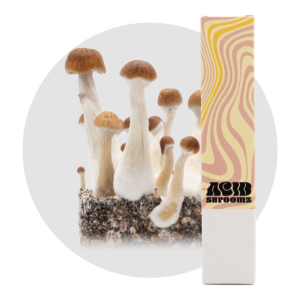
Psilocybe allenii produces attractive mushrooms with caps that can vary considerably in size, typically ranging from around 1.5–9 cm across. Young caps have a rounded shape and gradually become broader and flatter as they mature, sometimes developing a slight depression in the center.
Their coloration changes noticeably with moisture. Moist caps typically display warm orange-brown to caramel-brown tones, while drier specimens become considerably lighter and more yellowish.
The stems are slender and generally reach around 4–7 cm in length. They range from white to yellowish and may become slightly thicker toward the base. Additionally, handling or damaging the mushrooms can cause noticeable blue bruising.
Allenii is a temperate wood-loving species that naturally grows on decomposing wood, wood chips, and other woody material. In particular, Allenii commonly grows in mulched areas and woodchip beds.
The species develops strong mycelial networks through woody material and is associated with fruiting during the colder part of the year. Its natural range stretches along western North America, where the temperate climate provides conditions well suited to this seasonal growth pattern.
These characteristics give Allenii a distinctly different growth cycle from the tropical and subtropical P. cubensis varieties in our spore collection.
Although Psilocybe allenii is closely related to Psilocybe cyanescens, it represents a separate species. One of the easiest visible differences is the cap: mature Allenii mushrooms generally lack the strongly wavy edges commonly associated with Cyanescens.
Interestingly, the species was known among mushroom enthusiasts before receiving its current scientific name. It was previously referred to informally as “Psilocybe cyanofriscosa,” although this name was never formally recognized.
In 2012, Jan Borovička, Alan Rockefeller, and Peter G. Werner officially described the species and named it after John W. Allen, who collected and supplied the original material used for its description.
Allenii is also sometimes called the “Cyclone Psilocybe,” a nickname associated with a spiral-shaped mycelial growth pattern observed on agar by Paul Stamets.
Together, its North American origin, wood-loving nature, distinctive appearance, and relatively recent scientific recognition give P. allenii its own identity among temperate Psilocybe species.
| Spawn phase 1 (grain) | |
| Suitable substrates | Sterilized grains like brown rice, rye, oats, millet, popcorn, or wild bird seed (WBS). |
| Colonization time | Approximately 25–30 days under suitable conditions. Actual colonization time may vary between cultures. (2/3 filled liter jar / 26°C / shaken at 25-33% colonization). |
| Temperature | Around 24–26°C |
| Light | Low light or darkness. |
| Spawn phase 2 (hardwood) | |
| Suitable substrates | Hardwood chips such as beech or oak, adequately hydrated and heat-treated. |
| Temperature | Around 24–26°C |
| Light | Low light or darkness. |
When handling the Allenii spore syringe, it is crucial to follow proper safety precautions to avoid contamination and ensure a successful growth process. Here are some general guidelines to keep in mind:
For more in-depth information, visit our blog.
Consider using a flow hood or a still air box (SAB) for added sterility during substrate inoculation.
This product has a limited shelf life and is non-returnable. For more information, see our page on reflection period and returns.

Reviews
There are no reviews yet