


Are you curious about how to make cheap and easy mushroom spawn? The Uncle Ben’s tek makes it possible. This method, popularized in 2019 by Reddit user Shroomscout, has secured a permanent place among home growers. Read on for a step-by-step explanation of how it works and what to pay attention to.
Table of Contents
What is the Uncle Ben's tek?
It is a simple DIY method for making mushroom spawn using pre-steamed rice bags from the supermarket. Developed in 2019 by Reddit user Shroomscout, this technique spread rapidly via platforms such as Reddit and Shroomery, where home growers shared their experiences and results.
The method uses pre-steamed brown rice, such as Uncle Ben’s Ready Rice, which is available in most supermarkets. Since the rice is sterile-packed and contains the necessary nutrients for healthy mycelium growth, it is an ideal substrate.
The process is straightforward: the rice only needs to be inoculated with spores or a liquid culture. Under the right conditions, the fungus colonizes the bag’s contents, and then it can be used as spawn for further cultivation.
Thanks to the low entry threshold and the fact that no sterilization equipment is required, Uncle Ben’s tek has become a popular and accessible method within the mushroom growers community.

What are the pros and cons of Uncle Ben's tek?
Although it is a popular and accessible method for making mushroom spawn, unfortunately, it also has a number of disadvantages. It is simple and suitable for beginners but offers less control over sterility and yield than more advanced methods.
To help you better understand this, we have created a clear table below. It will help you easily determine whether the Uncle Ben’s tek is right for you.
| Pros | Cons |
|---|---|
| ✅ Simple and accessible – no expensive or complex equipment needed. | ⚠️ Higher risk of contamination compared to professionally sterilized grains or lab-based techniques. |
| ✅ Uses ready-to-eat pre-steamed rice from the supermarket. | ⚠️ Limited yield – the small amount of rice per packet restricts the amount of spawn, and therefore the final harvest. |
| ✅ Quick to start – no preparation or cooking required. | ⚠️ Not always consistent – different rice brands or formulations can lead to varying results. |
| ✅ Ideal for beginners who want to experiment with making spawn. | ⚠️ Difficult to shake the spawn to speed up colonization. |
| ✅ Requires very little – just a syringe with spores or liquid culture, a warm environment, and some patience. | ⚠️ Hard to monitor – the packets are often only partly transparent, making it difficult to track progress. |
| ✅ Discreet and easy to obtain – the packets look like regular food rather than cultivation material. | ⚠️ Creates relatively more plastic waste – since each packet contains only about 250 grams, you’ll often need several. |
How to use the Uncle Ben's tek
The Uncle Ben’s tek is surprisingly easy to carry out. With just a few materials and a clean workspace, you can start your own mushroom spawn in no time. Below, you will find an overview of the necessary materials and a clear, step-by-step plan for the process.
Materials

Essential
- Packet(s) of pre-steamed rice
- Liquid culture or spore syringe
- Micropore tape
- Scissors
Recommended
- Disinfectant or alcohol wipes
- Hand sanitizer or isopropyl alcohol
- Nitrile gloves
- Face mask
- Warm space or incubator
- SAB (Still Air Box) or laminar flow hood
Step-by-step guide
1. Clean and organize your workspace and supplies
Choose a quiet place with minimal airflow, such as a small, enclosed room. Avoid areas with open windows or fans to minimize the risk of contamination. If you have a still air box (SAB) or a laminar flow hood, work inside it for extra protection against microorganisms.
Thoroughly clean your work surface with disinfectant or alcohol wipes, and ensure that all your supplies are within reach. Arrange them so that everything is within reach but does not get in the way while you are working. A clean and organized workspace is essential for successful cultivation.

2. Massage the rice bags and push the rice down
Before inoculating, ensure that all rice grains are at the bottom of the bag. Gently massage the bag to loosen and sink the rice. This allows the mycelium to spread evenly through the rice, ensuring optimal colonization later on.
During this process, be careful not to crush or break the grains. Damaged grains can slow the growth of the mycelium and increase the risk of contamination.

3. Prepare for inoculation
Good preparation and hygiene are essential to preventing contamination. Begin by disinfecting your gloves with alcohol or disinfectant. Then, clean the outside of the rice bag, especially the area where you will inject. This reduces the chance of unwanted bacteria or fungi entering.
Do you have a syringe with a protective cap? Carefully remove the cap and attach the provided needle. Make sure not to touch the needle and keep it clean; touching it can lead to immediate contamination. If you touch the needle, heat it thoroughly with a lighter or burner to kill any bacteria.
Finally, ensure that all your materials are within reach and that you are still working in a clean, draft-free environment. Once everything is ready, you can safely proceed with the inoculation in the next step.


4. Inject the spores or liquid culture into the bag and seal it
Once everything is clean and ready, you can begin inoculating the rice bags. Pierce the packaging carefully with the needle and inject two to five milliliters of liquid culture or spore solution into each bag. Aim the liquid at different spots in the rice so the mycelium can spread evenly later.
Gently pull the needle back, then cover the puncture hole with a piece of (microporous) tape. This will prevent unwanted microorganisms from entering the bag during colonization.


5. Cut out a small triangle and tape it shut
The bag needs minimal gas exchange to promote healthy mycelium growth. This allows the mycelium to “breathe” during colonization.
First, disinfect your scissors with an alcohol wipe. Then, carefully cut a small triangle out of the top of the bag. Make sure the opening is large enough for air to circulate, but not so large that unwanted microorganisms can enter. One helpful method is to match the width of the opening to the width of your micropore tape in advance.
Apply a piece of micropore tape over the cut-out section. This tape allows air to pass through while keeping dirt and bacteria out. This provides the mycelium with the optimal amount of oxygen for healthy growth and successful colonization.


6. Label the bag and begin the incubation process
After inoculation, label each bag with the species or strain and the date of inoculation. This will make it easy to determine how long each bag has been colonizing and identify the variety later on.
Then, place the bags in a warm, stable location with a temperature around 27 °C. This temperature promotes rapid and healthy mycelium growth. Colonization can also occur at lower temperatures, around 20–21 °C, but the process is considerably slower, and there is a greater risk of contamination. In all cases, avoid direct sunlight and significant temperature fluctuations.
Check the bags regularly during colonization to monitor progress. This allows you to identify problems such as slow growth or contamination early on and take action where necessary.

7. Open the bags once they are fully colonized
Open the bag when the mycelium has taken over the entire bag. You can check on its progress through the window at the bottom of the bag. Once the rice is completely white, the mycelium has colonized a significant part of the substrate. At an optimal temperature of around 27 °C, this process usually takes two to three weeks.
The images below illustrate that, on occasion, not all rice grains are completely colonized. If this happens, you can carefully remove the uncolonized grains before continuing with the cultivation process. This will not negatively impact the mycelium’s development in the next phase.


Unfortunately, contamination is not uncommon with Uncle Ben’s Tek. For instance, the rice bag pictured below fell on the floor during incubation, likely allowing mold spores to enter the substrate. The contamination became visible through the window at the bottom of the package quickly.


8. Mix your spawn with bulk substrate or proceed directly to fruiting
Once the mycelium has fully colonized the rice, there are two options. You can either mix the spawn with a bulk substrate to maximize yield or proceed directly to the fruiting stage.
Option 1: Mix the colonized spawn with a suitable bulk substrate in a monotub or shoebox. The increased moisture and nutrients will almost always lead to a better yield.
Option 2: Proceed directly to fruiting with or without a casing layer (a thin top layer of peat, coconut fiber, or vermiculite, for example) to maintain stable moisture content.
The best approach depends on your experience level, available space, and desired result.

Tips for the best results
- Work as sterile as possible. Choose a room with minimal air movement and clean everything thoroughly before starting. A homemade still air box (SAB) is an easy and inexpensive way to do this at home.
- Inoculate more bags than you need. This way, if one or more bags become contaminated, you will still have enough left for your project.
- Check regularly for contamination. Look through the transparent window at the bottom of the bag. Immediately remove any contaminated bags from the cultivation area to prevent the contamination from spreading.
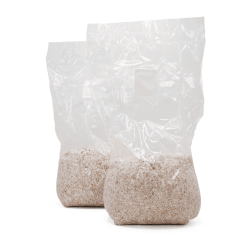
Conclusion
The Uncle Ben’s Tek is an accessible way to make mushroom spawn, though it is not the most reliable method. Due to the use of non-sterile procedures and the fact that the bags are often not 100% airtight, there is a real risk of contamination. Colonization is sometimes irregular, making it difficult to accurately assess progress.
Nevertheless, it is a good introductory method for those who want to experiment and learn the basics of mycelium growth.
For better results and more certainty, check out our articles on making rice spawn and rye spawn. Or, choose our sterilized rye in a grow bag with an injection port for a professional, safe, and consistent foundation for your next project.